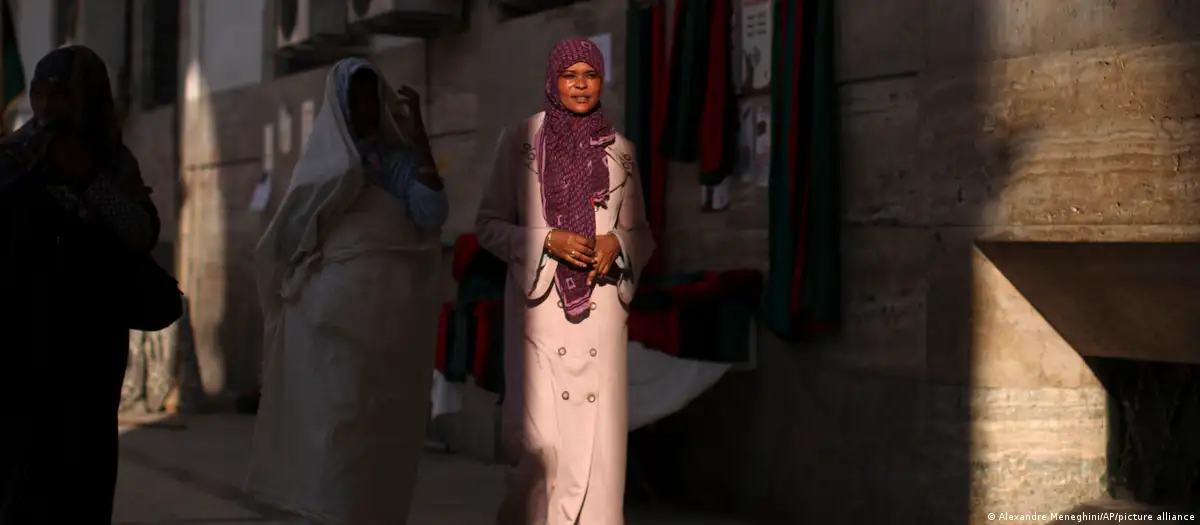
Across Libya’s vast desert landscapes, women play a central role in sustaining families, preserving cultural traditions, and supporting the social and economic life of their communities. Despite the challenges of living in remote areas where access to education, healthcare, and employment opportunities can be limited, women continue to demonstrate resilience, adaptability, and leadership.
Without the enforcement of strict regulations and cooperation between northern and southern countries, the vital waterway risks becoming a lifeless zone as fish stocks plumet due to overfishing and pollution.
n the Libyan coast of Sirte, fisherman Mokhtar Al Rammash, in his forties, prepares for another fishing trip aboard his worn-out plastic boat. He untangles his frayed nets, damaged by time and overuse, and points to the surface of the sea, now scattered with waste.
“These nets now catch only plastic,” he says. “It feels like we’re cleaning the sea instead of earning a living from it.”
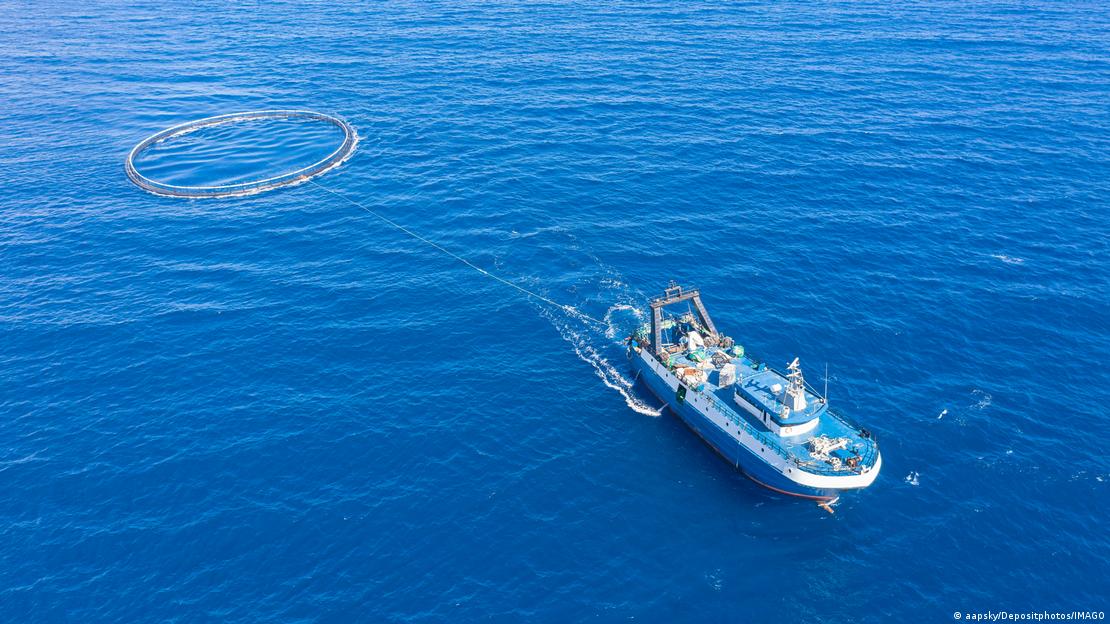
But plastic pollution is not Mokhtar’s only concern. He highlights a greater threat: industrial trawlers from neighboring countries that overfish the area and leave behind depleted waters.
Ongoing anxiety
Speaking to DW, Mokhtar explains that the large trawlers leave nothing in their wake. “They take everything, even the small, juvenile fish. The sea is being swept clean every day. If strict laws aren’t enforced soon, the Mediterranean will become lifeless.”
He gestures westward and adds, “From Tajoura to Janzour, the waters are polluted by sewage and factory waste. Pollution has wiped out sponge populations and decreased fish stocks. We’re waiting for serious action from the authorities. What’s happening here isn’t normal, it’s a continuous destruction of our only source of income.”
Mokhtar also points to haphazard coastal reclamation as a major problem, altering the marine environment and affecting bottom-dwelling species. “Some fish depended on specific seabed formations. Now their habitat is gone, and they no longer have a suitable place to live or reproduce.”
Despite efforts by fishermen to reach out to authorities, Mokhtar says the response has been non-existent. “We’ve sent letters and demands, but no one replies. Sometimes it feels like Libya doesn’t even have a Mediterranean coast.”
He concludes with frustration, “We have one of the longest coastlines in the region, and yet we import fish from abroad. It makes no sense. The government must take this reality seriously.”
Shared Struggles
Not far from Libya, the situation doesn’t appear to be any different on the Egyptian coast. In the Bahari area of Alexandria, Haj Abdel Nabi, a fisherman in his sixties, sat on the dock beside his boat. He inspected his net, which has yielded noticeably less catch in recent years.
Abdel Nabi pointed to his empty net, saying, “In the past, we used to come back with a hundred kilograms of fish, but today we get only 10, and sometimes, we return with nothing at all.”
With a tone full of frustration over the large ships that venture deep into the sea, leaving behind polluted waters and disrupting ocean currents, he said: “A single vessel catches more than all the local fishermen combined, yet no one responds to us or listens to our complaints.”
In Algeria, local environmental reports have shown ongoing depletion of fish stocks due to illegal overfishing, especially of juvenile sardines along the country’s western coast. Over 1,300 tons of these so-called “sardine seeds” fish smaller than 11 centimeters are caught annually, largely outside the legal framework. Researchers warn this undermines fish populations and disrupts the marine food chain, all in the absence of strict regulations and effective oversight.
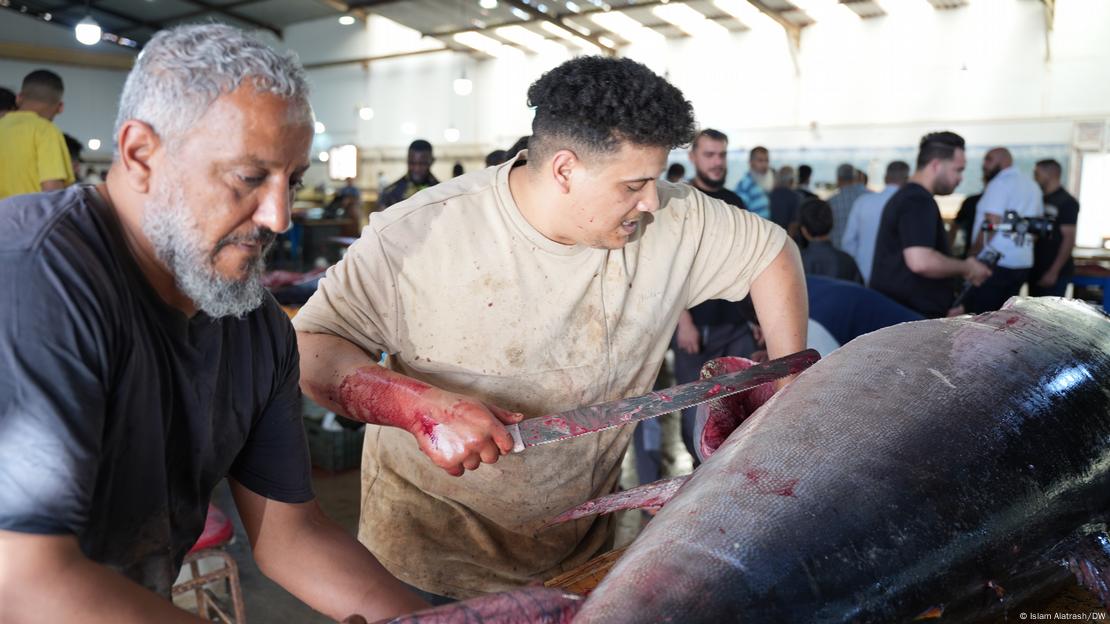
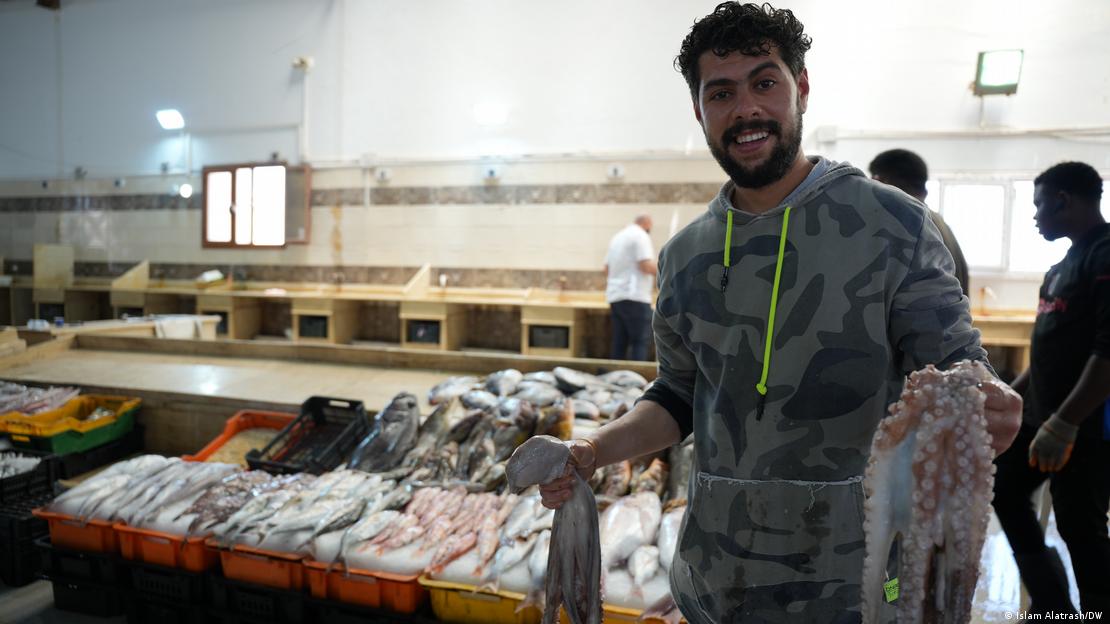
Two fishermen cut a fish in a fish market in Lybia / Credit: Islam Alstrah for DW.
Complex challenges
North African countries are facing a fragile maritime reality: declining fish stocks, rising pollution and climate change that is shifting marine currents and fish behavior.
But the challenge is not limited to the Global South. Northern Mediterranean nations are also facing environmental pressures, migration across the sea and competing economic interests.
As southern Mediterranean fishermen watch their livelihoods collapse, the world turned its eyes to Nice, France, which hosted the third United Nations Ocean Conference on June 9, 2025.
Egypt presented a national plan focused on restoring Lake Idku and Lake Manzala, building over 70 kilometers of natural barriers to protect coastal areas, and reducing plastic use through extended producer responsibility for plastic bag manufacturers. Environment Minister Yasmine Fouad also announced initiatives involving fishermen in waste recycling and water quality monitoring, stating, “Protecting the Mediterranean is no longer an environmental choice, it’s a social and economic necessity.”
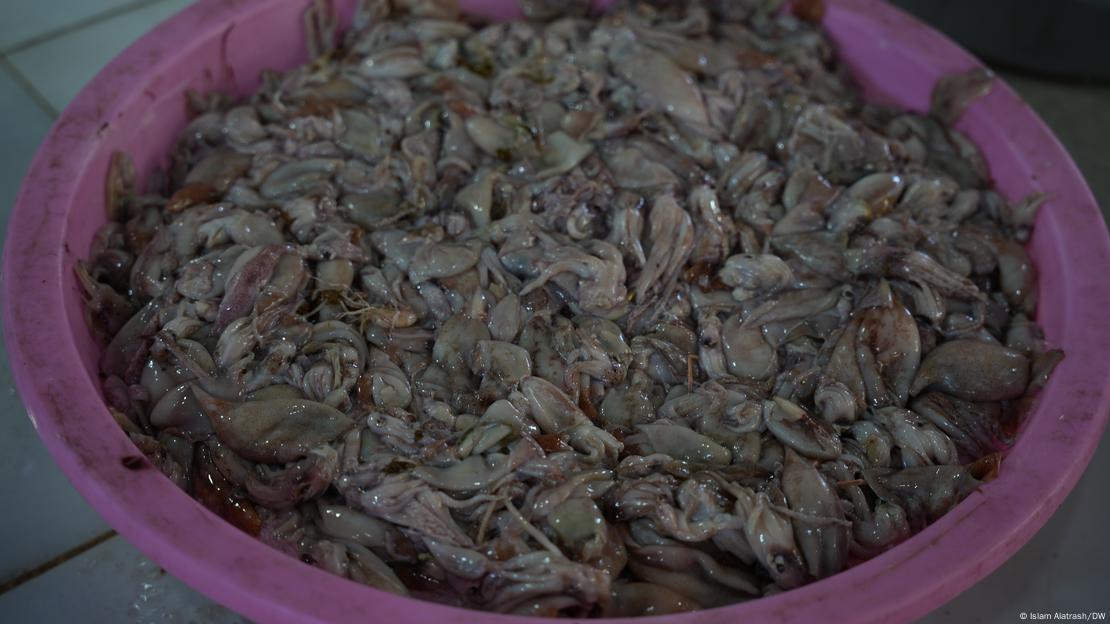
An array of small molluscs are on display, many barely the size of a fingertip
Diverse commitments
Morocco shared its perspective at the Africa for Oceans Summit, held alongside the main conference in coordination with France. Fisheries Minister Zakia Driouich led the session on Africa’s marine challenges, emphasizing Morocco’s commitment to sustainable fishing techniques and the integration of coastal communities into blue economy strategies. it also announced new partnerships with the International Maritime Organization to strengthen oversight of industrial fishing fleets in Mediterranean waters.
Algeria, for its part, announced a project to digitize fishing activity monitoring and connect its ports to electronic tracking systems in cooperation with the Union for the Mediterranean. The aim: to reduce marine resource losses and automatically detect violations.
By contrast, Libya’s participation was limited to a request for technical support from UNESCO and the European Union to resume environmental studies that have been suspended for over a decade, according to Presidential Council head Mohamed Al-Menfi in a statement to DW. No timeline or clear plan was offered.
Tunisia, through its foreign minister, emphasized the importance of comprehensive national strategies to protect marine resources strategies based on participatory approaches that combine environmental and developmental priorities.
The midway treaty
The Nice summit saw 55 countries sign the High Seas Treaty, which aims to protect 30% of the ocean by 2030. This milestone in global ocean governance will come into effect once 60 countries have ratified, enabling the establishment of protected zones even beyond national jurisdictions.
Also unveiled was the “Nice Plan for the Ocean,” which calls for the involvement of fishermen in environmental data collection, banning deep-sea fishing in fragile ecosystems and supporting blue economy projects as a path to sustainable development.
Germany pledged 20 million euros to support these efforts in Global South countries and launched a 400-million-euro fund for ocean protection. France committed to increasing the percentage of “strictly protected” waters in its maritime territories from 0.1% to 4% by 2026. Italy allocated 6.5 million euros for monitoring oil spills in the Mediterranean using satellite sensing technologies.
Yet, these pledges were met with skepticism.
“It’s hard to believe when some of the biggest funders are also the world’s worst polluters.” Former Tunisian captain and now marine environmental activist Samir Sheikh Al-Zaghnani told DW,
A climate hotspot
The Mediterranean has long been classified as a climate hotspot. Scientific studies show that oceans have absorbed about 90% of the excess heat generated by human activity since the industrial revolution. This has placed additional stress on fragile marine ecosystems in the region.
Despite the promises made in Nice, the voices of fishermen like Mokhtar and Abdel Nabi remain excluded from decision-making circles.
“We know the sea, and we can protect it, but we don’t have the tools,” Mokhtar told DW. “If they keep giving us promises while giving others the nets, there’ll be nothing left for us.”
Spanish Ministry of Environment marine policy advisor Manuel Torres told DW, “We cannot protect the Mediterranean without involving the South. There is no real protection without Tunisia, Morocco, Libya and Algeria. The divide begins when local fishermen are left out of the policymaking process.”
While the Nice summit has put a spotlight back on the Mediterranean, it won’t bring real change unless pledges are turned into enforceable policies. Organizers hope this edition will become a turning point for ocean governance, much like the Paris Climate Agreement was ten years ago.
This story was produced as part of the 2025 UNOC Fellowship organized by Internews’ Earth Journalism Network. It was first published in Arabic in DW on June 24, 2025.
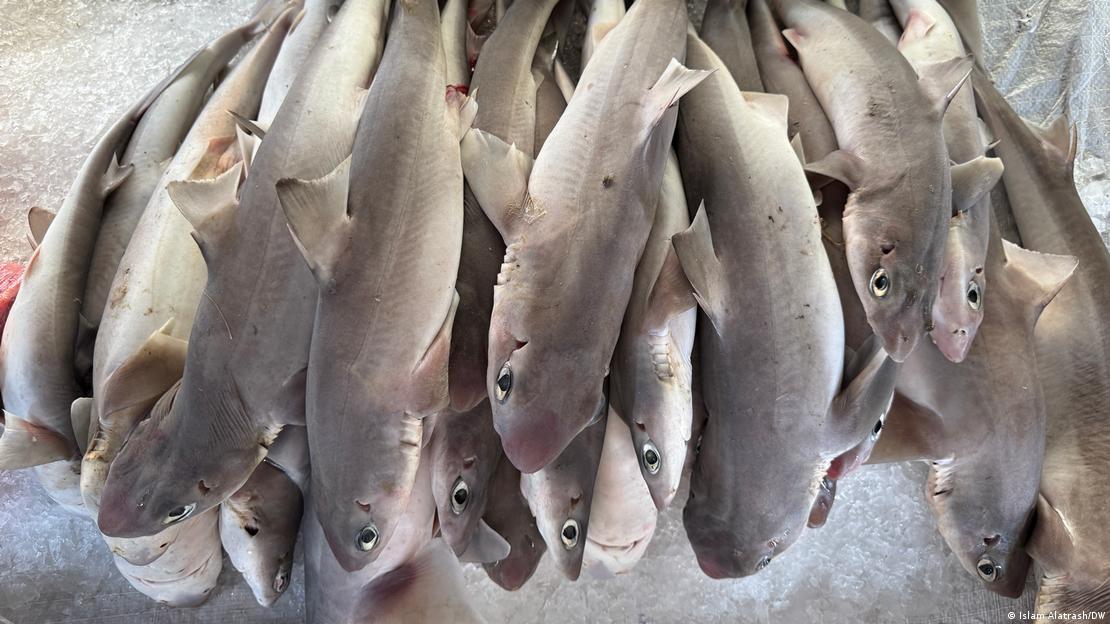
Banner image: Fishes displayed in a fish market, Libya / Credit: Islam Alatrash for DW
Along Libya’s coast, sharks — including breeding females — are being sold unchecked. With little enforcement and growing financial pressure on fishermen, vulnerable species are spiraling toward extinction.
At a fish market in the Libyan capital of Tripoli, stallholders shout to attract customers to trays piled high with popular frozen seafood such as octopus, squid and shrimp.
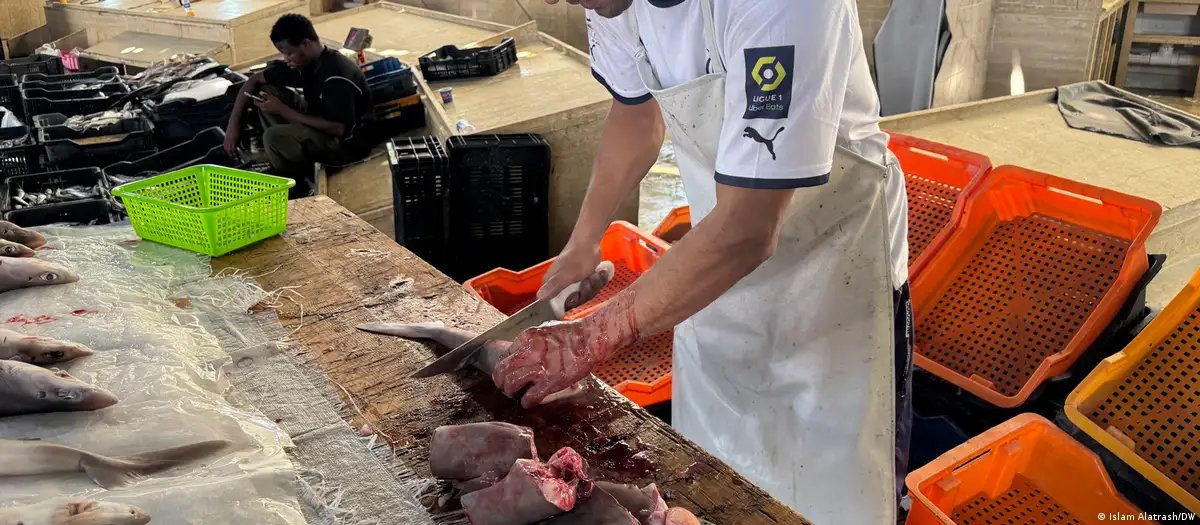
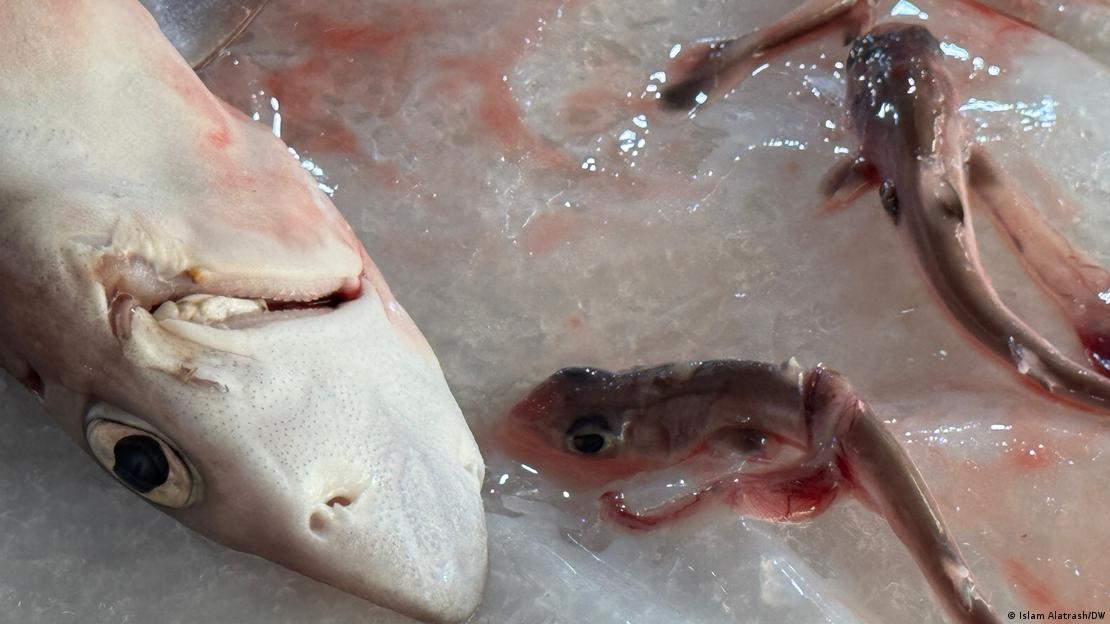
But that’s not all that’s on display. Some trays contain sharks with their bellies still swollen with eggs. Among them are dozens of longnose spurdogs, known locally as “kalb al-bahr,” which have clearly been caught mid-breeding season.
One fisherman, who asked to remain anonymous for security reasons, said there is no monitoring at sea or at the point-of-sale in Libya.
Longnose spurdog sharks are openly sold on markets amid limited enforcement of fishing regulations
And because “kalb al-bahr” can be sold relatively cheaply, making it popular with local consumers, fishers trying to survive the country’s worst economic crisis in modern history ignore the restrictions on fishing during breeding seasons.
“We catch them even though we know they are carrying eggs,” he said. “We sell them in the market because they bring money.”
The species has a slow reproductive cycle, with females only producing one to six pups per pregnancy, so it’s highly vulnerable to sustained fishing pressure.
Community engagement
Longnose spurdogs are not the only species at risk. A 2021 studyfound that oceanic shark and ray populations have declined by 71% since 1970. IUCN dataindicates that around 38% of shark and ray species are threatened with extinction.
Libyan waters are considered among the most important shark habitats in the region. When marine biologist Sara Al Mabruk found social media images of fishermen hauling the animals, including endangered species, from Libyan waters, she decided to take action.
Using social media herself, she reached out to fishermen and asked them to share photos and information about the species when they encountered them in their nets.
“We have achieved a lot through social media alone,” she told DW.
Gradually, her posts evolved into an awareness campaign, and her name became associated with shark conservation. She also uses local radio stations and meets fishers directly to explain the status of sharks in Libyan waters and why they require urgent protection.
Some of the sharks were pregnant, the babies killed before they could hatch
“The moment I realized my efforts were making an impact was when a fisherman contacted me to say he had found a small pregnant shark and returned it to the sea,” she said, adding that she is confident that she can protect “endangered sharks in our waters.”
“If the situation continues unchanged, further declines in its numbers are likely over the next decade,” she said.
She is concerned about the classification of the “kalb al-bahr,” and says other species initially listed in that category became designated as “threatened” once more accurate data became available. It is “a scenario we do not want to discover too late,” she said. Not least because sharks play a critical role in the regulation of marine ecosystems.
Because sharks regulate mid-level predators, their decline can trigger imbalances in the food web. This can ultimately affect commercially important fish such as sardines and mullet, on which many coastal communities depend.
Protection on paper
The Marine Biology in Libya Society, a nongovernmental organization, has documented 30 shark species in Libyan waters, noting that several are regularly caught and displayed for sale in markets.
Although Libya has a fisheries law dating back to 1989 that grants authorities the power to regulate seasons and fishing gear, it is not strictly enforced — and it is nearly impossible to implement offshore without compliance from the fishing fleet. It also does not include a list of prohibited species.
Regional coordination in terms of monitoring shared waters, data exchange and enforcing conservation measures is also limited.
Abundant shark catches
Though modern fishing techniques don’t always distinguish between species, making it easy to accidentally catch sharks that might be returned to the sea or taken ashore for sale, Abdullah Al-Fitouri said there are signs of growing awareness.
“We must protect the sea,” said the small-scale fisherman in the eastern city of Tobruk near the Egyptian border. “If sharks are in danger, our livelihoods are in danger too.”
He believes groups such as the Life Organization for Marine Conservation, which he co-founded with other fishermen in 2021, can help to preserve endangered species.
“Fishermen today understand the importance of marine biodiversity,” he said, adding that they are constantly learning new things about the issue, even as Libya’s recent history has been marked by turmoil.
North African and European countries are having to tackle a growing range of problems in the Mediterranean Sea, from plastic pollution to rising temperature.
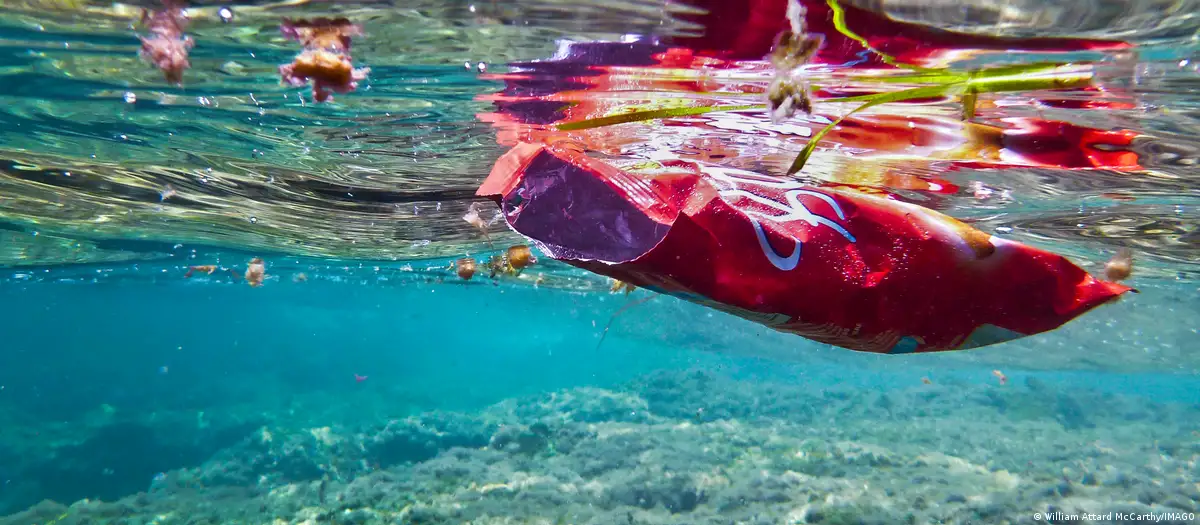
Plastic pollution is only one of the challenges facing the Mediterranean
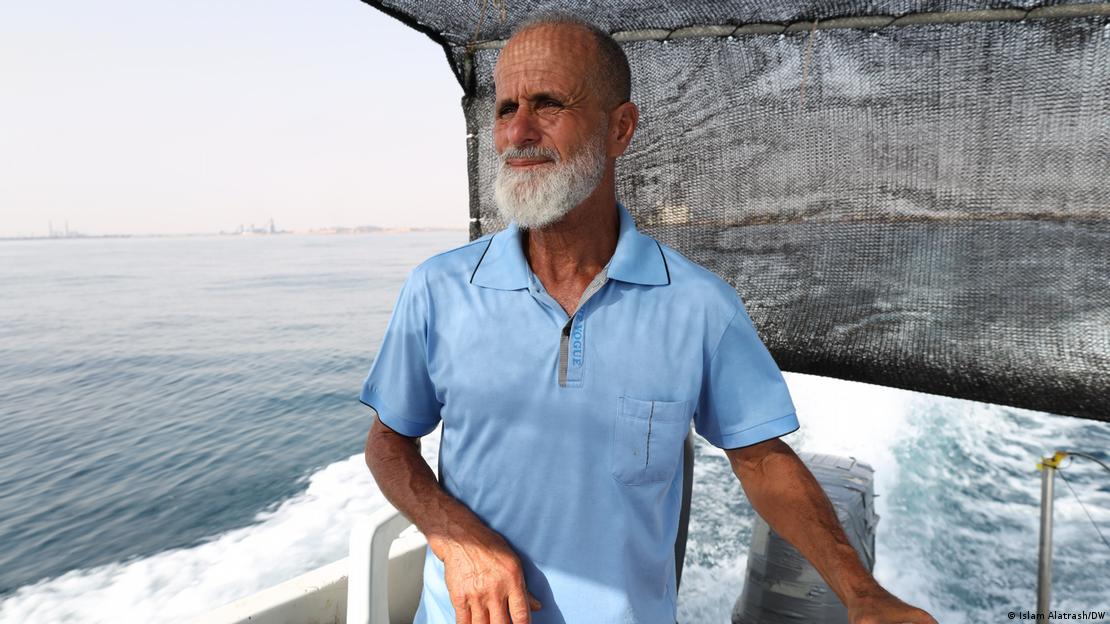
In the Libyan coastal city of Sirte, Mokhtar al-Rammash prepares to take his beat-up plastic boat out on another fishing trip. Untangling his worn and fraying nets, he points to the waste-scattered surface of the sea.
“These nets now catch only plastic,” he said. “It feels like we’re cleaning the sea instead of earning a living from it.”
Plastic trash, which according to the United Nations enters the Mediterranean Sea at a rate of 730 tons a day, is not his only concern. After decades of fishing the waters that connect southern Europe and North Africa, he said industrial trawlers that “take everything, even the small, juvenile fish,” are sweeping the sea “clean every day.”
Added to that, he said sewage released by towns near the Libyan capital, Tripoli, is killing fish and sponge populations, while coastal reclamation is disturbing breeding grounds for certain species.
“What’s happening here isn’t normal,” said al-Rammash, adding that it sometimes feels as if Libya has no sea on the doorstep. “We have one of the longest coastlines in the region, yet we import fish from abroad.”
Mokhtar al-Rammash, who has been fishing in the Mediterranean for decades, has seen devastating changes in the sea
Al-Rammash said he and other fishermen hope the Libyan Environment Ministry will take action to protect the sea and what he describes as “a continuous destruction” of their only source of income. “We’ve sent letters and demands, but no one replies.”
Shared struggles
Along the coast near the Egyptian city of Alexandria, Haj Abdel Nabi sits on the dock inspecting his own nets. Now in his 60s, he recalls a time when the sea provided a rich catch.
“In the past, we used to come back with 100 kilograms of fish, but today we get only 10 and sometimes, we return with nothing at all,” he said.
He also said the trawlers are at least partly to blame, with a single vessel hauling “more than all the local fishermen combined.” Like al-Rammash, he said he has taken his concerns to the municipality and the Environment Ministry, but so far he has not received a reply.
Fishers are struggling to compete with bigger boats that take a bigger catch
Environmental reports from Algeria, which shares a coastline with Libya and Egypt, have shown ongoing depletion of species such as pilchard, which is important for the country’s fishing industry.
Algerian authorities told DW that 1,300 tons of “sardine seeds” — juvenile fish which are smaller than 11 centimeters (4.3 inches) in length — are caught annually, often illegally. Researchers warn that catching juvenile fish undermines populations and disrupts the marine food chain.
What are the solutions?
As local fishers like Mokhtar al-Rammash and Haj Abdel Nabi feel the combined weight of the problems facing the Mediterranean, Egypt has presented a national plan to improve its coastal environment.
The plan, presented at a conference in July, would restore two coastal lakes and build around 70 kilometers (about 43 miles) of shoreline protection in the form of sand dune dikes. Cairo is also aiming to reduce plastic use through extended producer responsibility that would impose fees on manufacturers and importers of plastic bags.
Environment Minister Yasmine Fouad also announced initiatives to provide additional income for fishermen, involving them in marine waste collection and recycling, as well as monitoring water quality for pollution.
“Protecting the Mediterranean is no longer an environmental choice. It’s a social and economic necessity,” she said.
It is also a climate necessity. Scientific studies show that oceans have absorbed about 90% of the excess heat generated by human activity since the Industrial Revolution in the 19th century, placing additional stress on fragile marine ecosystems. And experts say that increasing temperatures, declining rainfall and sea-level rise are among the factors impacting the Mediterranean Sea.
Are global ocean protection commitments enough?
Algeria recently announced a project that would digitize fishing activity monitoring and connect its ports to electronic tracking systems in cooperation with the Union for the Mediterranean, a 43-state intergovernmental organization.
In June, 55 countries signed the High Seas Treaty, which aims to protect 30% of the world’s oceans by 2030. This milestone in global ocean governance — which among other things will create protected areas and regulate activities such as fishing, shipping and deep-sea mining — will come into effect once 60 countries have ratified it. This could happen by the end of the year.
Fishers who rely on the sea for their living say the waters need to be better managed
une also saw 170 countries come together in France to announce the Nice Ocean Action Plan. It calls for involving fishers in environmental data collection, banning deep-sea fishing in fragile ecosystems and supporting blue economy projects as a path to sustainable development.
European countries have pledged to invest €1 billion (about $1.2 billion) in ocean protection initiatives over the coming years. This includes support for countries in the Global South, stricter marine conservation, and advanced monitoring of pollution in the Mediterranean.
But those who live from the sea are not all convinced by protection promises. “It’s hard to believe when some of the biggest funders are also the world’s worst polluters,” Samir Sheikh al-Zaghnani, a former Tunisian captain and now independent environmental activist, told DW.
Fishermen like al-Rammash would like to be more directly involved in protecting the waters around them. “We know the sea, and we can protect it, but we don’t have the tools,” he said. “If they keep giving us promises while giving others the nets, there’ll be nothing left for us.”
This article was originally written in Arabic. It was produced as part of the 2025 UN Ocean Conference Fellowship organized by Internews’ Earth Journalism Network
A 7-year-old girl with cystic fibrosis recently became a symbol of Libya’s healthcare crisis. Her family undertook an illicit journey to Italy to get her the care their own country didn’t provide.
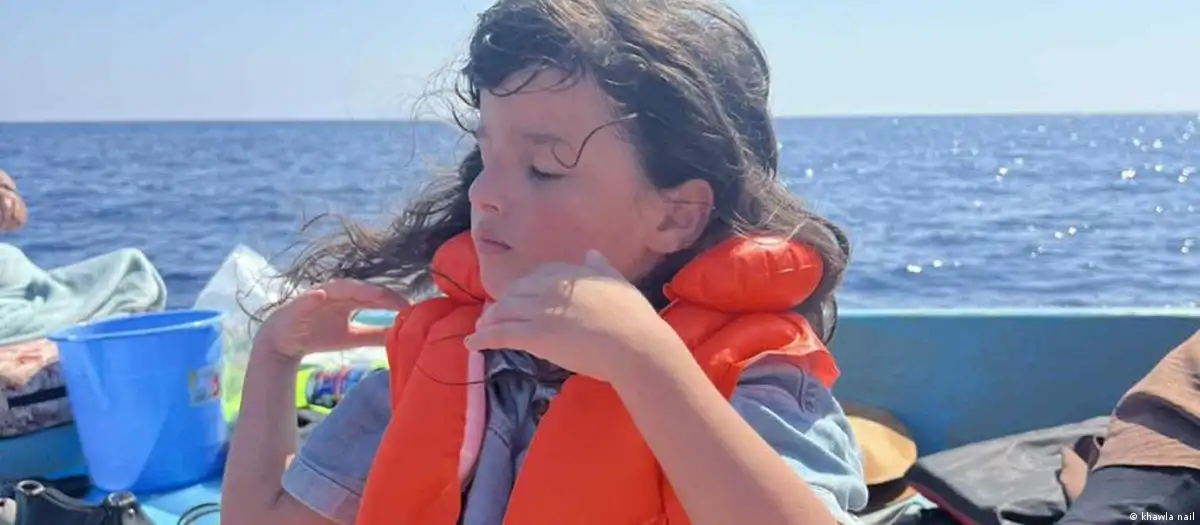
Libya’s healthcare crisis has a sad, new face. It is that of a tired 7-year-old girl, Sohan Aboulsoud, who suffers from cystic fibrosis, an inherited genetic disorder. Her family couldn’t get treatment for Sohan in Libya so they decided to dare the oft-deadly, illicit journey by boat to Italy in search of help on June 25.
When Sohan’s mother, Khawla Nail, shared the photo of her exhausted daughter on a smuggler’s boat online, it went viral on social media and was picked up by a number of media outlets.
A day later, dozens of families with children who also suffer from cystic fibrosis protested in the Libyan city of Tripoli. They demanded access to medication and the creation of diagnostic centers in Libya. The lack of such services threatens lives, they said.
Since the overthrow of Libyan dictator Muammar Gaddafi in 2011, Libya has been stuck in political chaos. Since 2014, Libya has been split in two, with opposing governments located in the east and west of the country. A UN-backed administration known as the Government of National Unity, or GNU, is based in Tripoli in the west — where Sohan’s family is from. Its rival, known as the House of Representatives, is based in the east, in Tobruk. At various times over the last decade, each government has tried — and failed — to wrest control from the other.
The ensuing instability has impacted the country’s healthcare system so that advanced hospitals are not being built and certain medicines are scarce or unavailable. In December 2021, a report by the World Health Organization found that in the southern and eastern regions of Libya, about a third of all facilities were “not functional,” while 73% and 47% respectively were “partially functional.”
Libyan families desperate
For the past seven years, Sohan’s family has paid for private lab tests in neighboring Tunisia and ordered medication through private pharmacies. Without this medication, Sohan would not have been able to survive until today.
“I submitted her file to the Libyan health authorities more than once but the response was always, there’s no budget,” Sohan’s mother told DW. “Everything was expensive, complicated and beyond our reach. And I watched my daughter’s condition deteriorate before my eyes. We exhausted every option for help in Libya.”
According to documents obtained by DW, more than 60 Libyan families have officially submitted requests to the Libyan Ministry of Health asking for cystic fibrosis treatment, a life-threatening illness that impacts the lungs, the digestive system and other organs. The documents include names and national ID numbers.
Mahmoud Abu Dabbous, head of the National Organization for Organ Donation Support in Libya, said that Sohan’s family was not the first that decided to risk the perilous journey, to Europe in search of healthcare. “It is a grave indicator of Libya’s failure to meet basic health needs,” Abu Dabbous said.
Sohan’s family hopes for medical treatment in Italy as mediation for their daughter’s chronic disease is unavailable in Libya
Around 10 days ago, Sohan, her mother and her stepfather boarded an overcrowded boat filled with Libyan families. “We didn’t leave because we wanted to migrate, it was because illness doesn’t wait,” Sohan’s mother said.
Many other irregular migrants are less successful on their journey from Libya or Tunisia toward Europe. According to the International Organization for Migration’s Missing Migrants Project, more than 63,000 have died or have gone missing since 2014. The actual number is most likely significantly higher as reliable data is often unavailable.
More than 63,000 aspiring migrants have gone missing or drowned in the past 11 years, according to official estimations
Libyan government offers words, no action
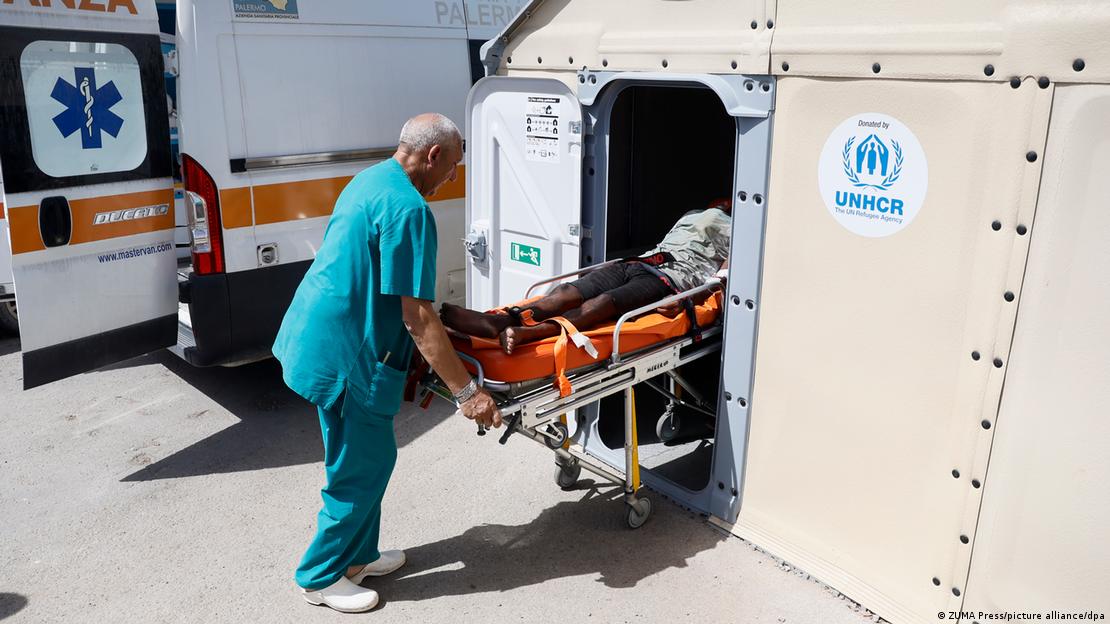
Once the family had arrived on Italy’s Lampedusa island, which is around 420 km (260 miles) by boat from Zuwara on Libya’s western coast, a frequent launching point for smuggling operations, the family was housed in a shelter, one without air conditioning. “Sohan’s disease, cystic fibrosis, does not tolerate heat or dehydration, even a slight drop in fluids could send her into intensive care,” her mother explained.
By then though Sohan’s pictures had gone viral on social media, prompting Libya’s GNU to issue a message saying it would cover the costs of the girl’s treatment in Italy.
“But they only contacted us once, then everything stopped. No official has called since and no concrete steps have been taken,” Sohan’s mother told DW.
DW’s attempts to contact the Libyan Ministry of Health for clarification were unsuccessful and at the time of publication, there had been no response.
That comes as no surprise to Tarik Lamloum, head of the Libyan human rights organization Beladi. In his experience, Libyan government support often ends after one initial political comment. The GNU reaction didn’t come”out of a sustained sense of responsibility,” he told DW. It was due to the social media furore, he speculated.
He’s also worried that Sohan’s story could provide a troublesome example for other families in similar stress. “One family already contacted me after the story went viral, asking about the journey’s details and whether it could be repeated,” he told DW. “Instead of glorifying a case in which a family had to cross the sea, the state should have provided care within the country,” he concluded.
Three killings of women in Libya have ignited a national debate over women’s safety and accountability, prompting demands for stricter legislation to protect women.
Within the first week of the current United Nations campaign in Libya, “16 Days of Activism against Violence Against Women and Girls,” the murders of three Libyan women have made headlines.
Social media influencer Khansa Al-Mujahid was shot while driving her car near Tripoli. Gynecologist Amani Hajja was killed by members of her family in the city of Misrata, and the body of a woman who was found in a basin southeast of Tripoli has yet to be identified.
UNSMIL strongly condemns the killing of Al-Khansa Mohamed Abdulmajid who was shot in Janzour district of Tripoli last night. The Mission extends its deepest condolences to her family, underscoring that this appalling incident highlights the urgent need to address all cases of… pic.twitter.com/qqk1enW91o
Al-Siddiq Al-Sour, attorney general in Libya’s western political capital Tripoli has called for an urgent and transparent investigation into the crimes.
However, Asma Khalifa, co-founder of the feminist, Libya-based think tank Tamazight Women’s Movement and research fellow at the German GIGA Institute for Middle East Studies, said she doesn’t have any hope that the investigation will be successful and that the perpetrators will be held accountable.
“Libya lacks the laws to protect women, and even if there were laws, there is no police to enforce them,” Khalifa told DW, adding that this basically amounts to impunity.
An attempt to create a comprehensive framework recognizing all forms of violence against women, including physical, sexual, psychological, economic and digital violence, has been pending since November 2023.
During the kickoff phase of the 16-day UN campaign, Hanna Tetteh, the UN secretary-general’s special representative for Libya and head of the United Nations Support Mission in Libya, reiterated the need for the law.
“Specifically, I would like to emphasize the urgency of adopting the draft law on protecting women from violence — a vital piece of legislation crafted by Libyan experts,” she said in a statement.
Specifically, I would like to emphasize the urgency of adopting the draft law on protecting women from violence — a vital piece of legislation crafted by Libyan experts,
“Violence against women is neither a new nor a sudden phenomenon,” Ali Omar, director of the UK-based nongovernmental human rights organization Libya Crimes Watch, told DW. “The rate of violations has been high for years.”
However, many crimes are never reported, Omar said.
“Victims are pushed into silence as they are scared of their perpetrators, social pressure, stigma and social or religious interpretations,” he explained.
Furthermore, certain factors make it almost impossible to obtain reliable data, Omar said.
For one, there are no reliable statistics about violence against women in Libya. The country has been without a centralized government since a NATO-backed revolt toppled and killed longtime leader Moammar Gadhafi in 2011. Three years later, the North African country split into rival administrations. Prime Minister Abdul-Hamid Dbeibah heads the Government of National Unity, or GNU, which is referred to as “Libyan government” on their official Facebook website. The administration is based in Tripoli and remains UN-backed and internationally recognized.
In the country’s eastern city of Benghazi, Prime Minister Ossama Hammad leads the Government of National Stability, or GNS. Hammad is supported by a strongman in Libya’s east, General Khalifa Haftar, and his Libyan National Army.
Both sides are backed by foreign governments and armed groups.
Also, cases of violence are rarely reported to governmental institutions due to the influence of armed groups, said Asma Khalifa.
In her view, this vacuum leaves women in the crosshairs of political intrigue and violence of armed groups.
“Armed groups not only control the country’s resources, but also Tripoli, where they are vying for influence by fighting with each other,” she said.
🧵 Libya’s Interior Minister Faces Backlash After Admitting Security Failure Following Activist’s Killing 1⃣ Libya’s Interior Minister in the Dbeibeh government, Imad Al-Trabelsi, has sparked widespread outrage after commenting on the killing of activist Khansa Al-Mujahid, saying… pic.twitter.com/IS5NYQOEMS
It’s not uncommon for women to marry someone “influential from an armed group just to make life a bit easier,” Khalifa said.
In her experience, this exposes Libyan women to a further level of violence.
“Since 2020, when I started tracking down news of women who have been killed, it has been mostly at home by their husbands who were either members of armed groups or previously fought in a war or experienced some sort of trauma,” she said.
Weapons in private homes are very common in Libya, she added.
Imad Trabelsi (2nd-L), interior minister in Libya’s Government of National Unity (GNU), has caused an uproar with his dismissive comment
Activists garner momentum
Khalifa also said a large part of Libya’s population has normalized domestic violence, and that a desensitized view of it “remains quite prevalent.”
At the end of November, Libyan activists launched an online campaign in Arabic that translates into “Do not marry a militia man,” following a statement by Imad Trabelsi, interior minister in Tripoli’s Government of National Unity.
After the killing of Khansa Al-Mujahid, he had commented in a video that the police couldn’t do anything in this case. He also said that it was impossible to place a police officer in front of every house or car, and that crimes happen even in major countries.
On Monday, four days after its launch, the campaign had garnered more than 19,200 clicks and over 3,000 comments on Facebook.
A push for stricter rules for girls and women from the government in Tripoli has sparked an outcry among women, rights organizations and activists. Observers fear the rules signal a return to authoritarian policies.
Libya’s administration in Tripoli is stepping up efforts to fend off European influence and protect Islamic social values, with a new “morality police” set to start operating in December.
The morality police will enforce strict regulations regarding women’s dress codes in public places, including mandating girls to wear a veil, or hijab, from the age of 9. Women will no longer be allowed to travel without a male guardian, and “inappropriate” behavior between women and men in public will also be banned.
“Libya is not a place for personal freedoms,” Emad Al-Trabelsi, the interior minister of Libya’s Tripoli-based, UN-backed Government of National Unity saidearlier this month, adding that “those seeking freedom should go to Europe.”
These words have sparked outcry among Libya’s overly young population, and the country’s women in particular.
“As a Libyan citizen, you, as a minister, have no right to tell me to leave for Europe if I disagree with your decisions,” Ahlam Bin Taboun, a Libyan civil researcher, told DW.
“Libya is a state that should be governed by laws applied to everyone, not by someone’s personal opinions,” she said.
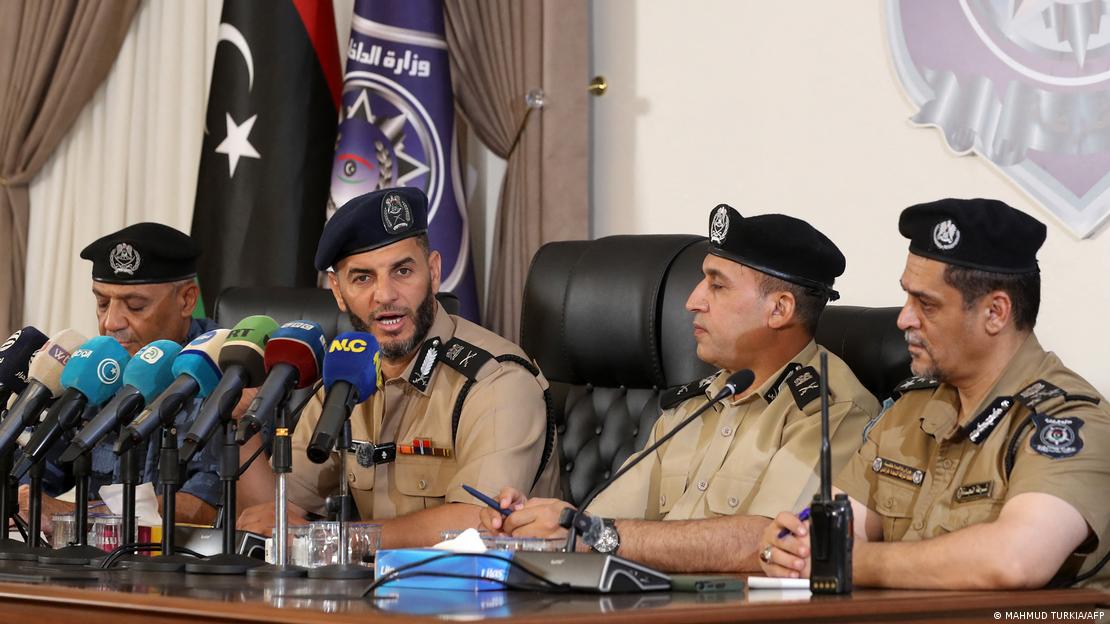
Emad Al-Trabelsi (speaking into mic), the interior minister of Libya’s Government of National Unity, wants to keep European social values out of his country
Even ahead of the introduction of the new force, the announced policies have already encouraged some men to hold women accountable to a stricter attire, several women told DW.
“A man approached my friend and me and asked if we were adhering to modesty rules,” said 26-year-old Yasmin, who asked to not publish her full name for fear of retribution.
“I was wearing a long skirt anyway,” she recalled. “But when I ignored him, he started threatening me and since then I am afraid to be in public.”
Zainab Tarbah, a popular Libyan journalist and TV anchor, experienced a similar situation while driving. “A male driver cut me off and pointed at this head, referring to my hair,” she said.
“I was scared,” she added, saying that “this man believed he had the authority to hold me accountable.”
According to Libya’s morality police, girls and women will have to wear veils in public
“Proposals to impose compulsory veiling on women and girls as young as nine, restrict interactions between men and women, and police young people’s personal choices with regards to hairstyles and clothing are not only deeply alarming, but also violate Libya’s obligations under international law,” said Bassam Al Kantar, Amnesty’s Libya researcher, on November 8.
He added that other proposals, such as requiring permission from male guardians for women to travel and violating individuals’ privacy through surveillance, constitute blatant violations of human rights.
Libya’s National Human Rights Committee has already filed a legal complaint against Al-Trabelsi with the attorney general.
“It is a blatant violation of individual freedoms,” said Ahmed Hamza, the head of the committee.
“The minister’s statements insult the Libyan society and constitute a punishable offense under the law,” he said, pointing to article 195 of the Libyan Penal Code, which prohibits violating citizens’ rights.
“These policies are merely a means to reinforce governmental control,” he said. “Amid severe political and economic fragmentation, it seems the government is using these initiatives to divert attention from core issues.”
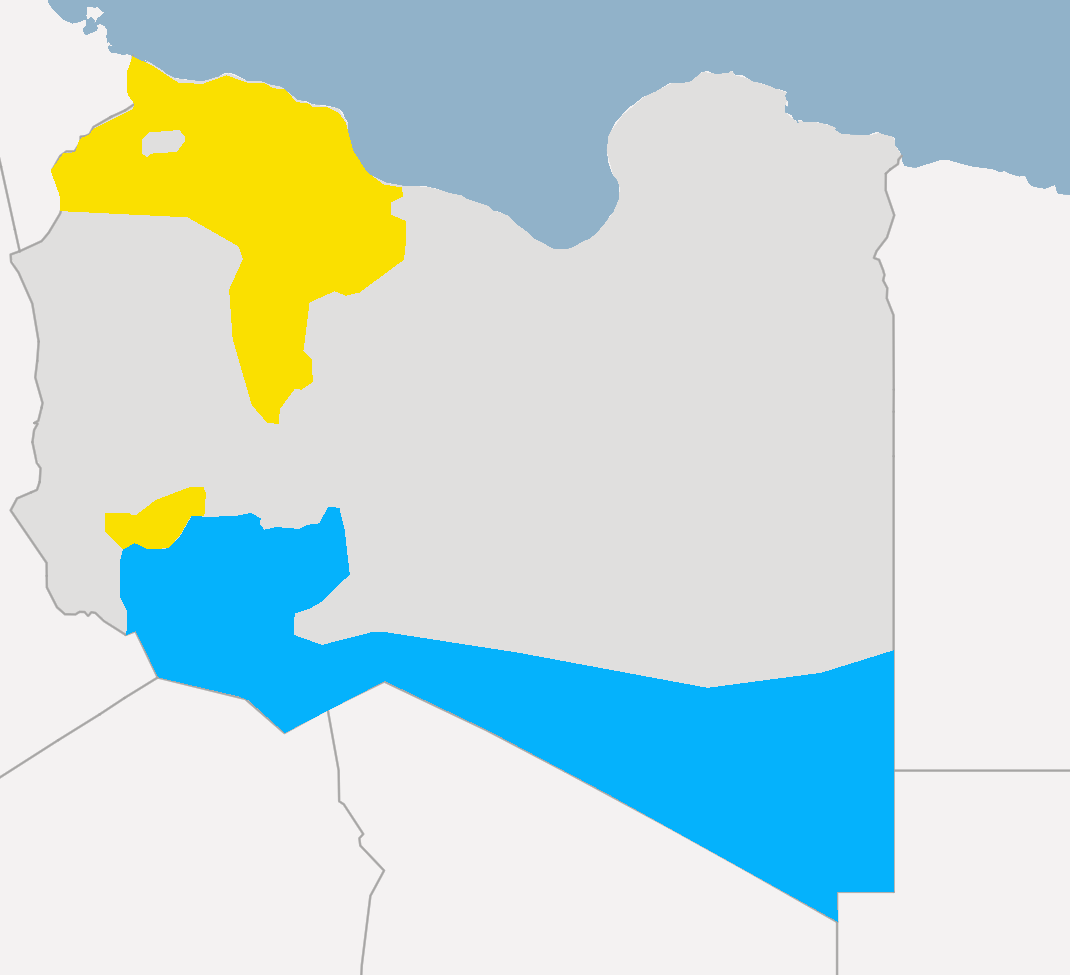
Libya – areas of military control
Libya has been split between two rival administrations since 2014. The west is under the administration of the UN-recognized government under Prime Minister Abdul Hamid Dbeibah in Tripoli. The east, meanwhile, is under the rule of General Khalifa Hiftar in Tobruk.
Jalel Harchaoui, an expert on North African security and a fellow at the Royal United Services Institute in London, told the British newspaper The Telegraph that installing a morality police would further give the government “vicious” powers to “streamline arrests” without the “formality of legal procedures.”
“The prime minister cannot project power in all of the capital, let alone beyond the capital. We’re talking about some neighbourhoods, in the best scenario,” Harchaoui told The Telegraph.
The proposed measures have reminded many in Libya’s overly young population of the decades of dictatorship under Gadhafi
And yet, for Libya’s population in the country’s west, this development will still remind them of the decades under Muammar Gadhafi’s dictatorial rule which ended in 2011.
The new morality police will, for example, be entitled to shut down barbershops or shisha bars that fail to meet the new regulations.
“Today, someone criticizes my hairstyle, and tomorrow, they might impose what I should wear,” Ahmed Qarqum, a 23-year-old university student, told DW.
“These policies create a suffocating environment that makes us feel alienated in our own country,” he added.
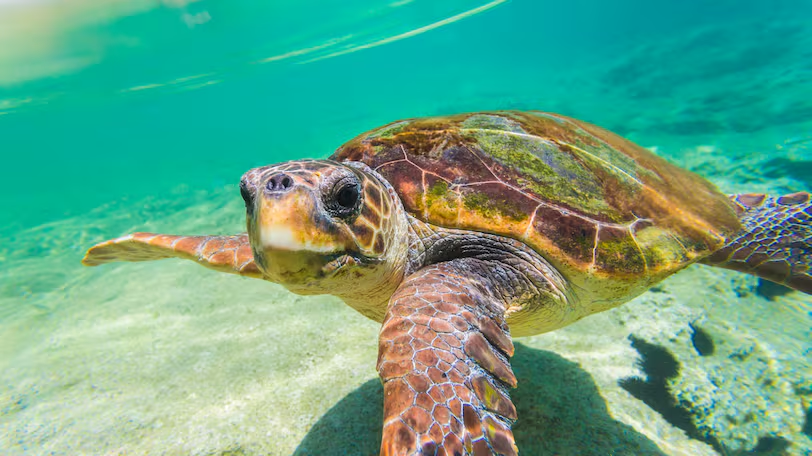
A local volunteer programme sees loggerhead nest numbers more than double in a decade
A plucky group of volunteers has scored a rare environmental win after their work to protect loggerhead turtles was rewarded with a doubling of the number of nests on the Libyan coast.
When a UN-funded programme to increase numbers of the endangered species was interrupted by a conflict that would span 12 years, the creatures were left to fend for themselves.
Conservationists consider the North African country’s 1,800km stretch of relatively undeveloped Mediterranean coastline to be one of the world’s most important refuges for loggerhead turtles burying their eggs.
Recognisable by their large, brawny heads and reddish-brown, heart-shaped carapaces, loggerhead turtles were listed as a threatened species in 1978 under the US Endangered Species Act.
Countries around the world, including Libya, have since banned their killing and capture.
Each year, thousands of loggerhead turtles drown in fishing boat dragnets, ingest toxic plastics and have their nesting grounds demolished by urban development.
Rising sea levels also threaten to swallow their beaches.
After the UN’s Libyan team disbanded, a group of Libyan volunteers relaunched the initiative themselves about a year into the war. And despite having no funding or official support, their efforts are paying off.
Nesting sites around Libya are on the rise, said the group, known as the Libyan Sea Turtles Programme.
In one stretch of sand monitored closely by the conservationists, they reported 494 nests last year, up from 271 in 2011.
Because of their migratory nature and globally scattered nests, there is no precise data on how many loggerheads exist.
Like nearly all sea turtle species, loggerhead populations have been in decline for decades because of human activity, though in recent years conservation work has helped stabilise them.
In the clutch
Around Libya’s coastal city of Misurata, a hotspot for nests, the volunteers patrol the beaches at night. That is when female turtles swim to shore and bury their eggs.
The volunteers search for turtle tracks in the sand that can lead to a clutch, or nest, of sea turtle eggs.
Loggerhead nesting season runs from May until July. From August to October, the eggs hatch.
A single clutch typically carries over 100 eggs. But only a tiny fraction survive to adulthood (estimates run from one in 1,000 to as few as one in 10,000).
The vast majority of hatchlings are picked off by birds and crabs, or simply dehydrate before wriggling into the water.
The volunteers try to maximise their terrible odds.
Teams of three to six move clutches to safer locations, away from prying animals and poachers, and place protective nets over them.
During hatching season they assist baby turtles in their short but perilous journey to sea.
Before UN funding was cut, the group put tracking devices on female turtles to monitor migration and nesting patterns.
But such tech is long gone. Today the all-volunteer programme grumbles that the state is disinterested.
“We are tackling a problem that the state has been unable to solve,” said Rabih Abu Zeid, 36, an environmentalist with the group.
For the turtles, threats are everywhere. Some Libyans prize sea turtle eggs for their supposed ability to cure disease and infertility.
Others hunt them for a healthy meal, said environmental activist Amer Algammal, 32.
And like elsewhere, in Libya their beaches are being destroyed. In 2009, the construction of a power plant near Sirte demolished one of Libya’s most active nesting sites, Qubeiba Beach.
Libya’s coastal waters are increasingly choked with industrial and agricultural waste, said Mr Abu Zeid.
Despite the enormous challenges, the last few years have been relatively good for loggerhead turtles.
The IUCN red list, which tracks at-risk wildlife, upgraded loggerheads in 2015 to “vulnerable” from “endangered,” citing intensive conservation efforts as behind the improvement, particularly in the Mediterranean, in a testament to the Libyan team’s work.
“What has kept turtle numbers up on Libya’s coast is the team’s interest in them, and giving the turtles a special environment that makes them happy to lay eggs,” said Mr Algammal.
This article has been published in collaboration with Egab
A Nigerian couple heading to Europe via Libya was separated and forced to suffer at the hands of ruthless smugglers. Thanks to a safe house supported by the UN and the medical charity MSF, the two were eventually reunited.
Migrants continue to suffer unspeakable crimes in Libya, according to the UN. The number of people trying to cross through the African nation to Europe has grown this year: the UN migration agency, IOM, says that there are more than 500,000 registered migrants in Libya, many of whom find themselves at the mercy of human smugglers.
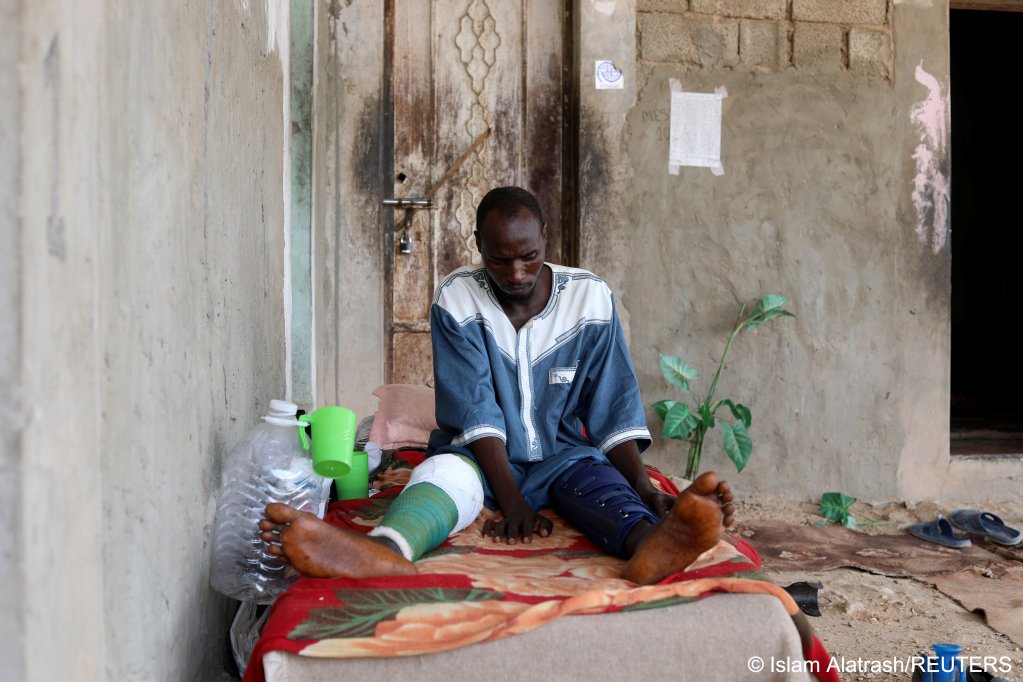
23-year-old Halima William crossed the desert from Nigeria to Libya in the hope of eventually reaching Europe, but was forced into prostitution. Her husband Mark, 27, also faced detention and abuse. Finally, each of them was able to escape and find refuge in a rare safe house.
A migrant sits on a bed at a shelter called ‘Safe House’ in Bani Walid, Libya on August 18, 2021 | Photo: Islam Alatrash/REUTERS
two were later reunited by mere chance at the safe house in the town of Bani Walid, where they have been staying for the time being. While their scars are still healing, they continue to hope to reach Italy eventually.
The couple’s story is one of many examples of the risks facing migrants who are aiming to reach Europe but who instead end up trapped in a country which remains chaotic and violent.
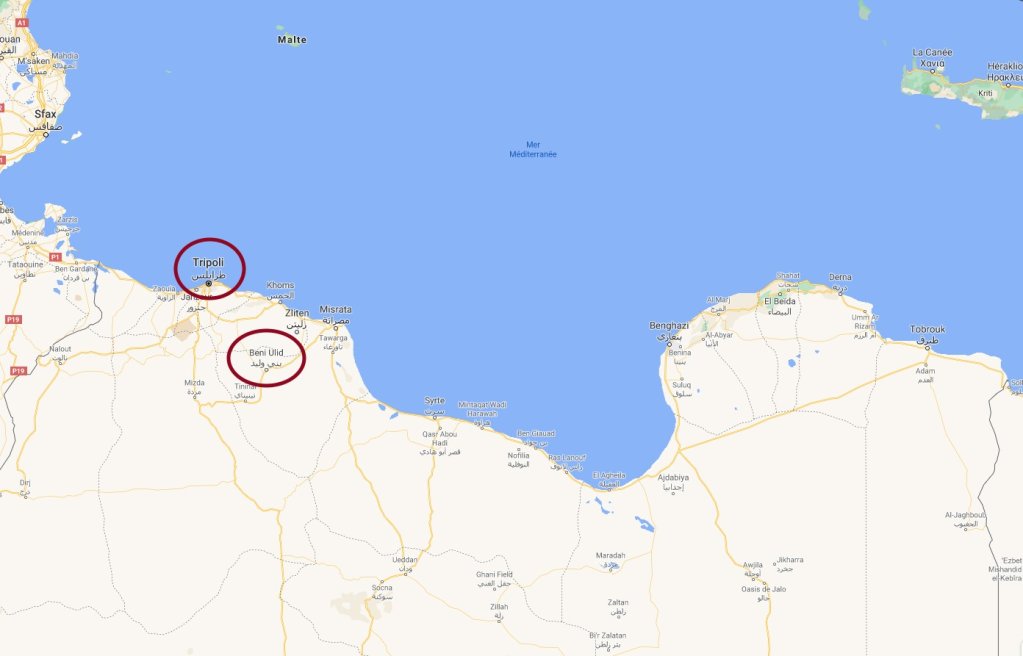
Mark left Nigeria first in 2016 and was smuggled into Libya across the desert border in a car. When he got to Bani Walid, 180 kilometers south of the Libyan capital Tripoli, he was detained by armed men and held for seven months for ransom. He eventually paid them and found work in Bani Walid as a builder, planning his reunion with Halima by phone to travel onwards.
Halima then came to Libya in 2018, using the same route as Mark. When she reached Tripoli she was sold into prostitution. Without a Libyan phone, she could not contact Mark.
Bani Walid is located 180 kilometers southeast of Tripoli | Credit: Google Maps
Tearful reunion at safe house
After four months Halima managed to escape and reach the safe house, which is supported by the United Nations and the medical charity Doctors Without Borders (MSF). The shelter provides food and medical care, and is funded by donations from locals. It has been in operation since 2015 and currently hosts 12 migrants.
Halima felt overjoyed when she found that her husband was already there: “I hug him and kiss him and start crying. He was crying too,” she told Reuters.
The founder of the safe house, Al-Hussein Bin Gharsa, said he wanted to show the true, kindly nature of Libyans and of the citizens of Bani Walid: “This is a city of generosity and hospitality.”
re roughly 700,000 foreigners living in Libya, many of them migrants who’d like to make their way to Europe. Some of those who were turned back want to try again.
Despite the recent capsize of an overloaded fishing boat packed with migrants off the Greek coast, heading from Libya to Europe, and what were likely hundreds of their deaths by drowning, Ali Majdi still wants to try and get to Europe.
The 28-year-old Syrian refugee has already tried to leave Libya for Europe once. He paid people smugglers in the coastal town of Zawiya $1,960 (€1,800) and was eventually able to board a boat crossing the Mediterranean. Majdi’s final goal is Germany, where his family now lives — he hasn’t seen them for eight years.
But the boat was intercepted by the Libyan coastguard and forced to return to Libya. “My hopes were shattered,” he told DW. “They forced me to come back here. I was devastated. But I’m determined to try again.”
“I know the risks,” he continued, “but I still want to sail across the Mediterranean. I need to reach Germany,” he stressed.
Libya, a hotspot for people smugglers
Majdi is just one of hundreds of thousands of foreigners in Libya. Some are happy to remain there, others are still trying to find a way out. And while Majdi was able to find a job in Libya, many migrants are in Libyan detention where they may be abused. According to United Nations numbers, there are around 706,00 migrantsin Libya, making up just over 10% of the country’s total population.
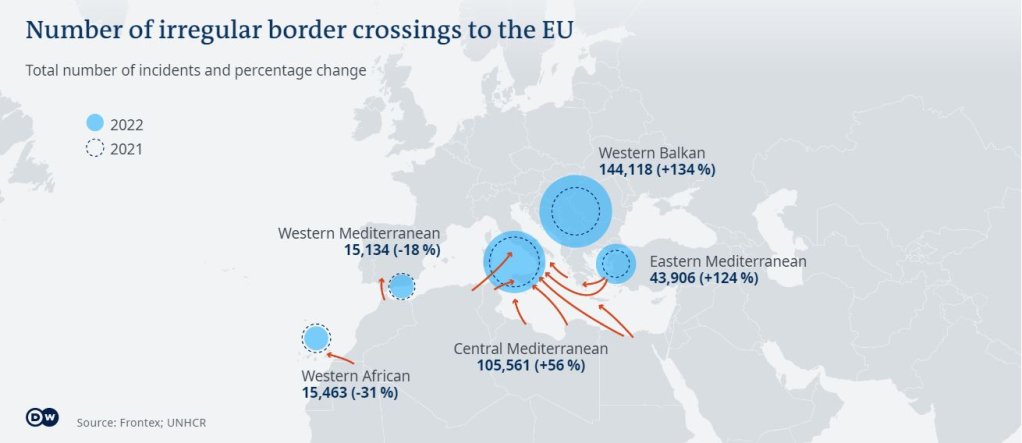
Still politically divided a decade after the revolution that toppled the country’s dictator, Moammar Gadhafi, the North African nation has become a popular waypoint for migrants — whether they’re crossing borders for economic reasons or they’re seeking asylum — because of the Libyan coastline’s relative proximity to Greek and Italian shores. More than 56,000 people made the trip across the sea to Italy in the first three months of this this year. Around half of them started their journey in Libya.
Of course, Majdi is worried about the risk that another crossing entails he told DW, and he admits that he’s also frightened of the Greek coast guard. “I’m worried they’ll stop me from reuniting with my family. Their actions towards migrants seeking safety and a better life are a terrible mistake,” he added, referring to the recent tragedy with the fishing trawler Adriana and the possibility that the Greek coastguard were somehow culpable in the deaths of hundreds of people who drowned when the overloaded boat capsized.
A new home for some migrants
Not everybody feels this way though. Rida Solan is originally from Pakistan and he too had initially wanted to come to Europe to work. Experts say that often Syrians, Pakistanis and Bangladeshis are able to fly into Libya from Syria on civilian flights before trying to make their way to Europe. People coming from elsewhere, including from Africa, often cross into Libya at land borders.
On his first attempt to get to Europe, Solan paid €2,000 ($2,175) to people smugglers in Zawiya, which is known as a hotbed of smuggling activity. But the 31-year-old was also apprehended and returned to Libya, this time by the Italian authorities.
Solan has now decided to stay put. He has managed to get a job at a juice shop in Misrata, a city around 220 kilometers (136 miles) further along the coast from Zawiya and is happy to be saving money.
“I vow not to consider migration again or risk my life,” he told DW. “And I decided to stay here and work in Misrata because it’s one of the safest cities in the country.”
Additionally, he added, “Libya is good because everything here is free, like electricity and water. So I can save more money than I could in Europe.” He is referring to the fact that the lack of a functioning state means that while electricity and water are provided, the collection of power or water bills is barely enforced, if at all.
The ‘safest’ way to Europe
the central Mediterranean route, the UN’s International Organization for Migration, or IOM, reports. The organization also said that in the same period 662 had died and 368 people were still missing.
The latter deaths and disappearances are a reason why Libya-based people smugglers promote themselves as providing a “safe journey” across the Mediterranean.
DW contacted one people smuggler advertising his services on the social media platform TikTok who boasted that he could offer “the safest trips to Europe.” In an interview conducted via the social media platform, the people smuggler, who would not give his real name, repeatedly emphasized that travelling with him was “extremely secure” and that he could organize travel between Tobruk in Libya and the Italian coastline for $2,500 per person.
Another people smuggler repeated this offer during an interview on WhatsApp. He also went on to claim his trips to Europe were the safest one could find in Libya.
Ismail, a former security guard for the Libyan government turned smuggler, further explains these kinds of promises. Ismail, who won’t give his full name or age because of the business he’s in, left his job to become a people smuggler because he earns much more money this way. After all, sometimes his government salary was not paid for months, he explained.
Irregular border crossings to the EU | Credit: DW Irregular border crossings to the EU | Credit: DW
Ismail also uses TikTok to attract customers and he spoke to DW via the platform’s direct messaging. He admits that his promotional videos on TikTok depict an unrealistic scenario of what life would be like for migrants once they reach their destination.
Migrants pay Ismail and his colleagues between $500 and $2,000 for the trip, depending on the kind of risks they’re willing to take. The lower prices get them a ride on a rubber inflatable which might take between 50 and 200 people aboard, and which is clearly more perilous. The highest prices include a bribe for Libyan border guards who help hide the migrants on commercial shipping.
“The work is hard and tiring,” he wrote to DW. “But it’s very profitable and I make an average of about two trips a week.”
A legal path to migration?
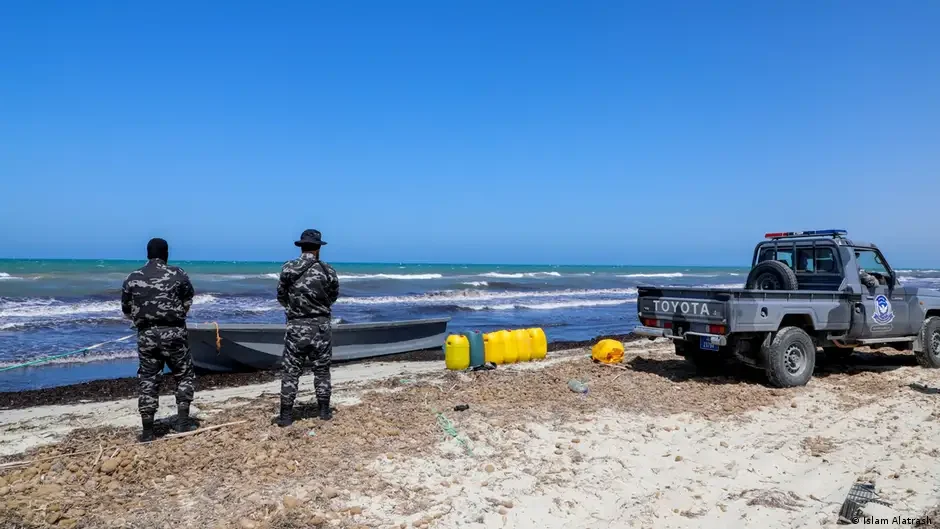
A coastguard staffer in Zawiya told DW that as long as assisting the migrants to leave Libya is so profitable, nothing will stop this business. He spoke off the record because he was not supposed to talk to journalists.
Experts and advocates in the field say that current policies to police the central Mediterranean route are not working and are leading to more deaths at sea and more abuses by people smuggling networks in Libya. An April 2023 investigation by the United Nations reported that there were “grave and widespread human rights violations” and “reasonable grounds to believe that crimes against humanity were committed” against migrants in Libya.
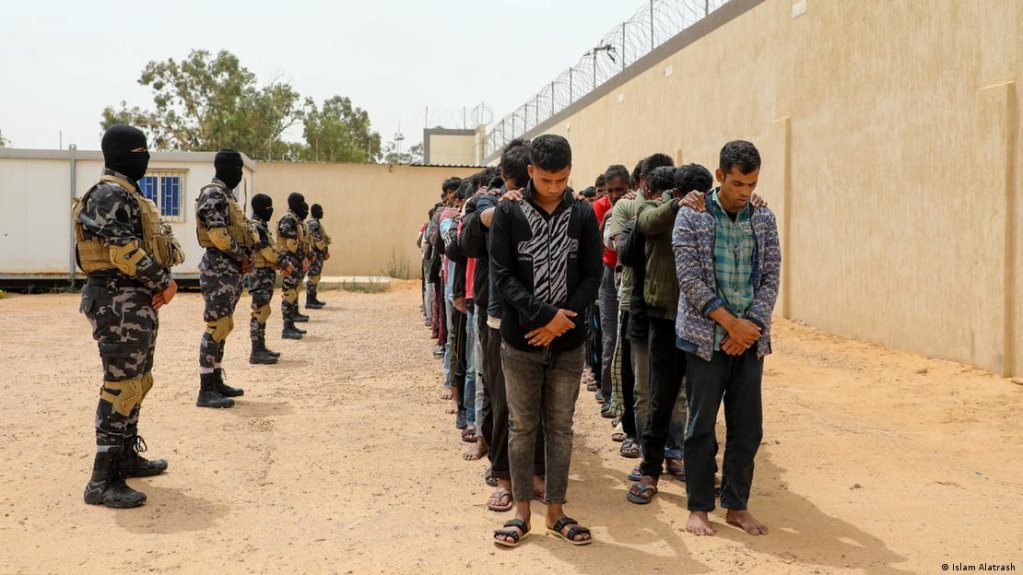
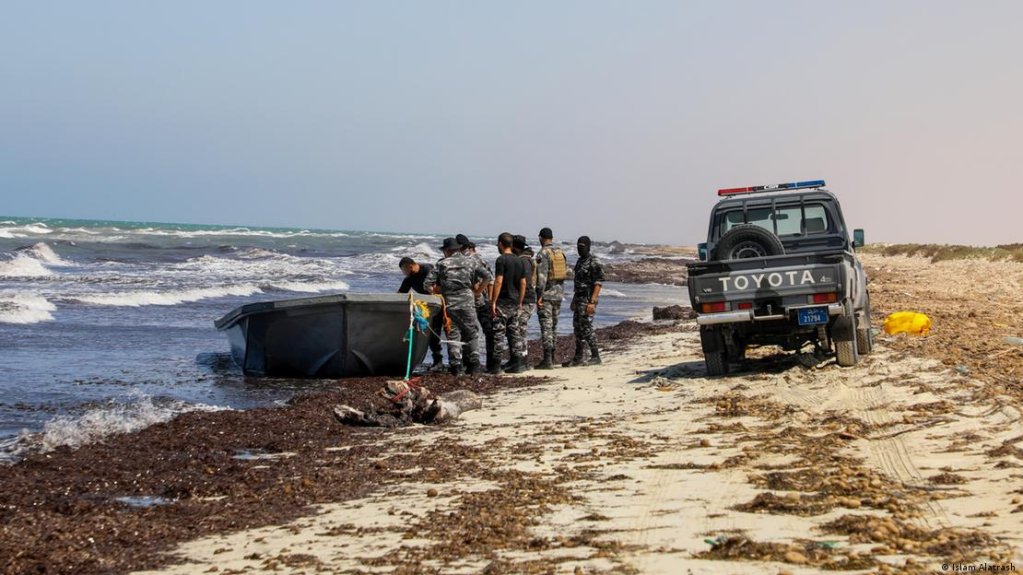
Libyan authorities are trained and funded by the EU to police migration
The European Union should be doing far more to help the would-be migrants stuck in Libya as well as those who still want to leave for EU countries, Marwa Mohamed, head of outreach at the advocacy organization, Lawyers for Justice in Libya, argued in a 2022 op-ed for the European Center for Refugees and Exiles. Offering migrants in Libya a legal pathway to migration would not only help them and prevent deaths and abuses, it would also help European countries solve their looming labor crises, she wrote.
“Committing to a rights-based and collaborative response to migration flows is the best way to protect migrants and refugees from grave crimes and serious human rights violations along the central Mediterranean route,” Mohamed concluded. “Doing so would contribute to the fight against the transnational crime of human trafficking by eradicating the demand and ultimately disempowering smuggling and trafficking networks.”
This article, originally published on DW, has been updated by InfoMigrants.
Cathrin Schaer contributed to this story from Berlin.
Author: Islam Alatrash
First published: July 9, 2023
Copyright DW – All rights reserved
DW is not responsible for the content of external websites