Saving Lives in the Mediterranean: A Mission That Requires North–South Cooperation

Without the enforcement of strict regulations and cooperation between northern and southern countries, the vital waterway risks becoming a lifeless zone as fish stocks plumet due to overfishing and pollution.
n the Libyan coast of Sirte, fisherman Mokhtar Al Rammash, in his forties, prepares for another fishing trip aboard his worn-out plastic boat. He untangles his frayed nets, damaged by time and overuse, and points to the surface of the sea, now scattered with waste.
“These nets now catch only plastic,” he says. “It feels like we’re cleaning the sea instead of earning a living from it.”
But plastic pollution is not Mokhtar’s only concern. He highlights a greater threat: industrial trawlers from neighboring countries that overfish the area and leave behind depleted waters.
Ongoing anxiety
Speaking to DW, Mokhtar explains that the large trawlers leave nothing in their wake. “They take everything, even the small, juvenile fish. The sea is being swept clean every day. If strict laws aren’t enforced soon, the Mediterranean will become lifeless.”
He gestures westward and adds, “From Tajoura to Janzour, the waters are polluted by sewage and factory waste. Pollution has wiped out sponge populations and decreased fish stocks. We’re waiting for serious action from the authorities. What’s happening here isn’t normal, it’s a continuous destruction of our only source of income.”
Mokhtar also points to haphazard coastal reclamation as a major problem, altering the marine environment and affecting bottom-dwelling species. “Some fish depended on specific seabed formations. Now their habitat is gone, and they no longer have a suitable place to live or reproduce.”
Despite efforts by fishermen to reach out to authorities, Mokhtar says the response has been non-existent. “We’ve sent letters and demands, but no one replies. Sometimes it feels like Libya doesn’t even have a Mediterranean coast.”
He concludes with frustration, “We have one of the longest coastlines in the region, and yet we import fish from abroad. It makes no sense. The government must take this reality seriously.”
Shared Struggles
Not far from Libya, the situation doesn’t appear to be any different on the Egyptian coast. In the Bahari area of Alexandria, Haj Abdel Nabi, a fisherman in his sixties, sat on the dock beside his boat. He inspected his net, which has yielded noticeably less catch in recent years.
Abdel Nabi pointed to his empty net, saying, “In the past, we used to come back with a hundred kilograms of fish, but today we get only 10, and sometimes, we return with nothing at all.”
With a tone full of frustration over the large ships that venture deep into the sea, leaving behind polluted waters and disrupting ocean currents, he said: “A single vessel catches more than all the local fishermen combined, yet no one responds to us or listens to our complaints.”
In Algeria, local environmental reports have shown ongoing depletion of fish stocks due to illegal overfishing, especially of juvenile sardines along the country’s western coast. Over 1,300 tons of these so-called “sardine seeds” fish smaller than 11 centimeters are caught annually, largely outside the legal framework. Researchers warn this undermines fish populations and disrupts the marine food chain, all in the absence of strict regulations and effective oversight.
Complex challenges
North African countries are facing a fragile maritime reality: declining fish stocks, rising pollution and climate change that is shifting marine currents and fish behavior.
But the challenge is not limited to the Global South. Northern Mediterranean nations are also facing environmental pressures, migration across the sea and competing economic interests.
As southern Mediterranean fishermen watch their livelihoods collapse, the world turned its eyes to Nice, France, which hosted the third United Nations Ocean Conference on June 9, 2025.
Egypt presented a national plan focused on restoring Lake Idku and Lake Manzala, building over 70 kilometers of natural barriers to protect coastal areas, and reducing plastic use through extended producer responsibility for plastic bag manufacturers. Environment Minister Yasmine Fouad also announced initiatives involving fishermen in waste recycling and water quality monitoring, stating, “Protecting the Mediterranean is no longer an environmental choice, it’s a social and economic necessity.”
Diverse commitments
Morocco shared its perspective at the Africa for Oceans Summit, held alongside the main conference in coordination with France. Fisheries Minister Zakia Driouich led the session on Africa’s marine challenges, emphasizing Morocco’s commitment to sustainable fishing techniques and the integration of coastal communities into blue economy strategies. it also announced new partnerships with the International Maritime Organization to strengthen oversight of industrial fishing fleets in Mediterranean waters.
Algeria, for its part, announced a project to digitize fishing activity monitoring and connect its ports to electronic tracking systems in cooperation with the Union for the Mediterranean. The aim: to reduce marine resource losses and automatically detect violations.
By contrast, Libya’s participation was limited to a request for technical support from UNESCO and the European Union to resume environmental studies that have been suspended for over a decade, according to Presidential Council head Mohamed Al-Menfi in a statement to DW. No timeline or clear plan was offered.
Tunisia, through its foreign minister, emphasized the importance of comprehensive national strategies to protect marine resources strategies based on participatory approaches that combine environmental and developmental priorities.
The midway treaty
The Nice summit saw 55 countries sign the High Seas Treaty, which aims to protect 30% of the ocean by 2030. This milestone in global ocean governance will come into effect once 60 countries have ratified, enabling the establishment of protected zones even beyond national jurisdictions.
Also unveiled was the “Nice Plan for the Ocean,” which calls for the involvement of fishermen in environmental data collection, banning deep-sea fishing in fragile ecosystems and supporting blue economy projects as a path to sustainable development.
Germany pledged 20 million euros to support these efforts in Global South countries and launched a 400-million-euro fund for ocean protection. France committed to increasing the percentage of “strictly protected” waters in its maritime territories from 0.1% to 4% by 2026. Italy allocated 6.5 million euros for monitoring oil spills in the Mediterranean using satellite sensing technologies.
Yet, these pledges were met with skepticism.
“It’s hard to believe when some of the biggest funders are also the world’s worst polluters.” Former Tunisian captain and now marine environmental activist Samir Sheikh Al-Zaghnani told DW,
A climate hotspot
The Mediterranean has long been classified as a climate hotspot. Scientific studies show that oceans have absorbed about 90% of the excess heat generated by human activity since the industrial revolution. This has placed additional stress on fragile marine ecosystems in the region.
Despite the promises made in Nice, the voices of fishermen like Mokhtar and Abdel Nabi remain excluded from decision-making circles.
“We know the sea, and we can protect it, but we don’t have the tools,” Mokhtar told DW. “If they keep giving us promises while giving others the nets, there’ll be nothing left for us.”
Spanish Ministry of Environment marine policy advisor Manuel Torres told DW, “We cannot protect the Mediterranean without involving the South. There is no real protection without Tunisia, Morocco, Libya and Algeria. The divide begins when local fishermen are left out of the policymaking process.”
While the Nice summit has put a spotlight back on the Mediterranean, it won’t bring real change unless pledges are turned into enforceable policies. Organizers hope this edition will become a turning point for ocean governance, much like the Paris Climate Agreement was ten years ago.
This story was produced as part of the 2025 UNOC Fellowship organized by Internews’ Earth Journalism Network. It was first published in Arabic in DW on June 24, 2025.
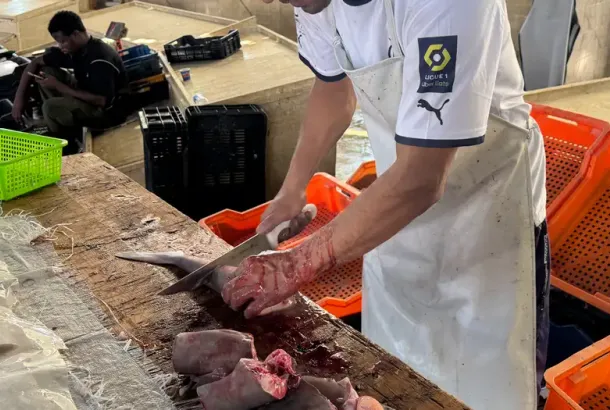
Banner image: Fishes displayed in a fish market, Libya / Credit: Islam Alatrash for DW
Share Artical